Five-Minute Acupressure Points for Stress at Your Desk
Five simple acupressure points you can press at your desk for tension and stress, how to press them, and when to see a practitioner.

 Written byFlourish TCM ClinicTraditional Chinese Medicine & skin care · Yaletown, Vancouver
 Reviewed byTabasom (Tabi) Mirshahi, R.Ac., R.TCM.P.
Five-Minute Acupressure Points for Stress at Your Desk

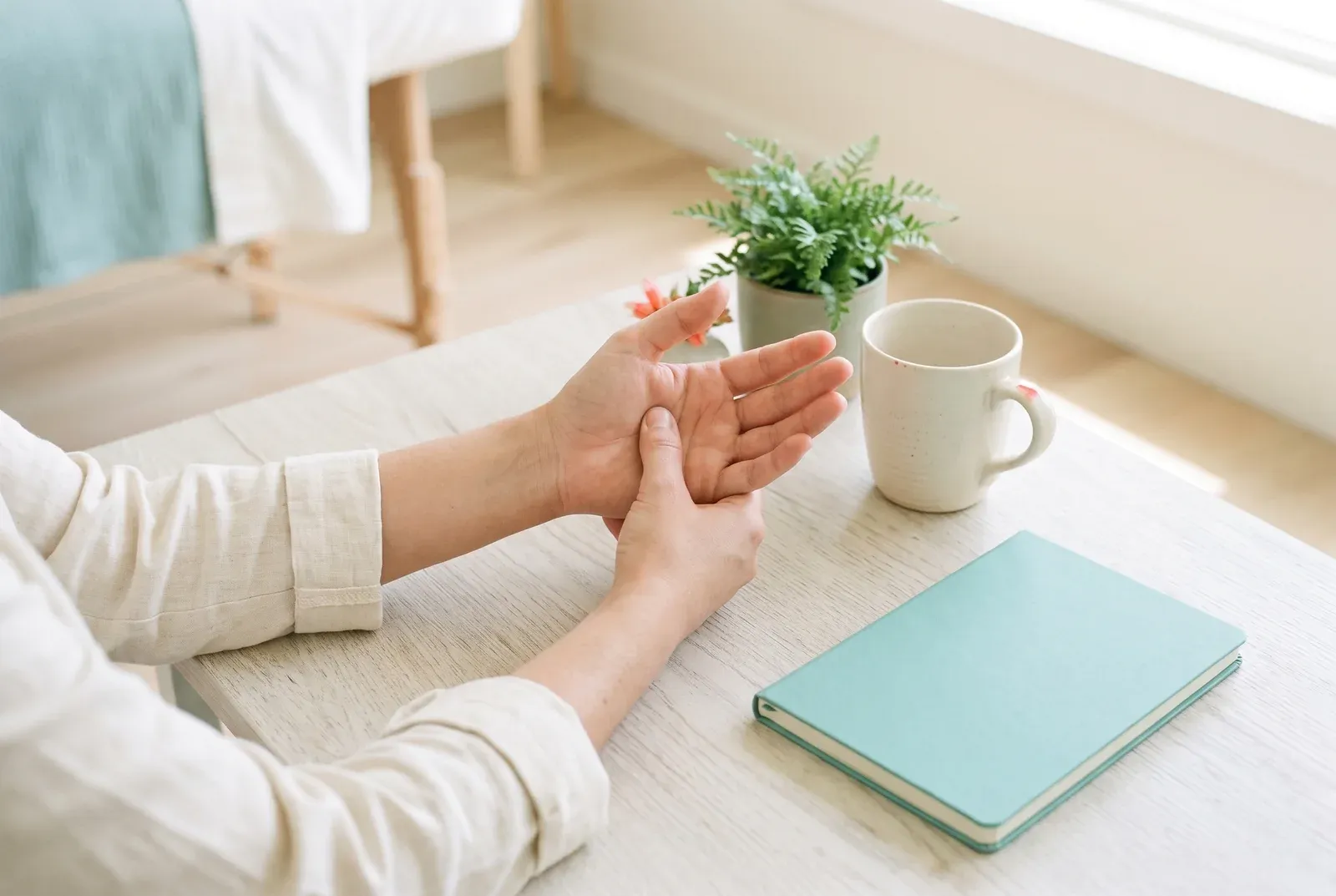
Acupressure means pressing acupuncture points with your fingers instead of needles. It's a simple way to take a calming pause at your desk. Five commonly used points are Yintang (between the eyebrows), Neiguan (inner wrist), Shenmen (wrist crease), Fengchi (base of the skull) and Hegu (between thumb and finger). Press each gently for about a minute while breathing slowly. Avoid Hegu if you're pregnant.
How to press a point
- Find the point (see the illustrations).
- Use your thumb or middle finger to press firmly but comfortably. You're aiming for a dull, pleasant ache, not pain.
- Hold steady pressure or make small circles for about 60 seconds.
- Breathe slowly, with a longer exhale than inhale.
- Do both sides where the point is paired.
Acupressure is a self-care habit. In TCM, it's the same principle used in TuiNa massage.
Point 1: Yintang (between the eyebrows)
Where: midway between the inner ends of your eyebrows. How: gentle pressure or small circles with your middle finger, eyes closed. Traditionally used for: calming the mind, and easing tension around the forehead and eyes.
Point 2: Neiguan (PC6, inner wrist)
Where: on the inner forearm, about three finger-widths above the wrist crease, between the two tendons. How: press with the opposite thumb. Traditionally used for: calming, and settling the stomach. It's the point used in motion-sickness wristbands.
Point 3: Shenmen (HT7, wrist crease)
Where: on the wrist crease, on the little-finger side, in the small hollow just inside the tendon. How: gentle pressure with your thumb. Traditionally used for: calming the "Shen" (spirit), for restlessness and sleep.
Point 4: Fengchi (GB20, base of the skull)
Where: at the back of your head, in the hollows either side of the neck muscles, just under the skull. How: hook your thumbs into both hollows and press gently upward, letting your head rest back into your hands. Traditionally used for: neck tension and tension headaches. Great after long screen sessions.
Point 5: Hegu (LI4, between thumb and index finger)
Where: on the back of the hand, at the highest point of the muscle when you press your thumb against your index finger. How: firm pressure with the opposite thumb and index finger. Traditionally used for: headaches and general tension. ⚠️ Avoid Hegu during pregnancy. It's traditionally avoided because of concerns about stimulating contractions.
A five-minute routine
- Sit comfortably, feet flat, shoulders down.
- Three slow breaths.
- Yintang, 1 minute.
- Fengchi, 1 minute.
- Neiguan, each wrist, 30 seconds.
- Shenmen, each wrist, 30 seconds.
- Hegu, each hand, 30 seconds (skip if pregnant).
- Roll your shoulders and look away from the screen.
Pair it with the desk habits in Neck and Shoulder Tension from Desk Work.
When to see a practitioner
Self-acupressure is a nice habit, but it has limits. For ongoing neck and shoulder tension or stress, a TuiNa & DDS Acupressure Massage works on many points and muscles at once and is bookable now. Acupuncture is on the waitlist.
See a doctor for severe or unusual headaches, numbness or weakness, or anxiety that's affecting daily life. In a crisis, call or text 9-8-8.
Where to book
A 30-minute TuiNa & DDS session fits a lunch break at our Yaletown clinic, two Canada Line stops from Downtown Vancouver and close to Gastown.
Frequently asked questions
Does acupressure work?
Many people find it calming; research on specific points is mixed.
How hard should I press?
Firm enough for a dull, pleasant ache, never sharp pain.
How often can I do this?
Several times a day is fine.
Is acupressure safe in pregnancy?
Some points, including Hegu, are traditionally avoided; ask a practitioner.
What's the difference between acupressure and TuiNa?
Acupressure is one part of TuiNa, which also uses kneading and stretching.
Sources
- World Health Organization. WHO standard acupuncture point locations in the Western Pacific Region. 2008. (iris.who.int)
- Au DW, et al. Effects of acupressure on anxiety: a systematic review and meta-analysis. Acupunct Med. 2015. (pubmed.ncbi.nlm.nih.gov)
- Lee A, et al. Stimulation of the wrist acupuncture point PC6 for preventing postoperative nausea and vomiting. Cochrane Database Syst Rev. 2015. (pmc.ncbi.nlm.nih.gov)
Information on this site is general and isn't a substitute for advice from your physician.
Related to this article
Body Wellness
TuiNa & DDS Acupressure Massage
TuiNa & DDS Acupressure Massage combines TuiNa, a Chinese massage technique that works along the meridians and acupressure points, with the DDS bio-current system's gentle micro-current. At Flourish TCM Clinic in Yaletown, Vancouver, it's $110 for 30 minutes or $170 for 60 minutes, with Amir Norouzi.

Body Wellness
Acupuncture
Acupuncture is a Traditional Chinese Medicine treatment in which a registered acupuncturist places fine, sterile needles at specific points on the body. At Flourish TCM Clinic in Yaletown, Vancouver, a 45-minute session costs $170. Appointments open once a registered acupuncturist joins our team; join the waitlist.

Body Wellness
Relaxation Massage
Relaxation Massage is a calming, Swedish-style full-body massage using long, flowing strokes to help you unwind. At Flourish TCM Clinic in Yaletown, Vancouver, it's $170 for 60 minutes or $250 for two hours, with Amir Norouzi. It is a relaxation service, not registered massage therapy.
Body Wellness
Ayurvedic Indian Head Massage with Reiki
The Ayurvedic Indian Head Massage with Reiki is a relaxing treatment for the scalp, face, neck and shoulders, based on a traditional Indian head massage technique and infused with Reiki. It's offered by Lida Fazlinejad (Lida Fazli) at Flourish TCM Clinic in Yaletown. Appointments aren't open yet; join the waitlist.